19 products

RJ45 Plugs and Coax F Connectors | Cat5e, Cat6, Cat6A and Cat8 Modular Plugs, RG6 Compression and Push-On, F81 Couplers, Adapters and Terminators
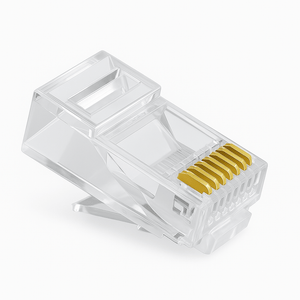
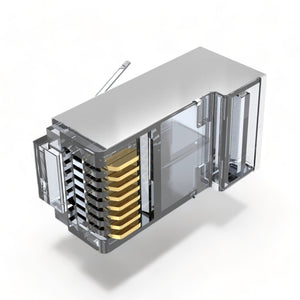
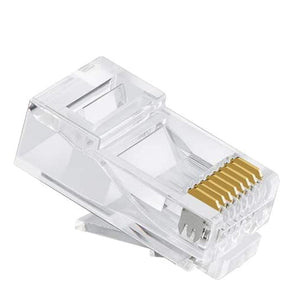
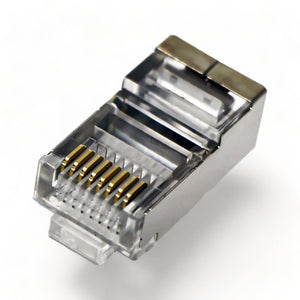
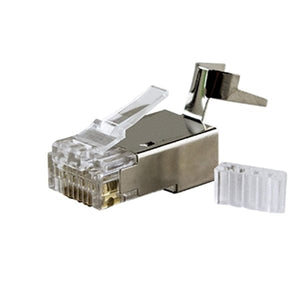
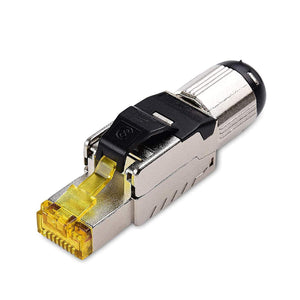
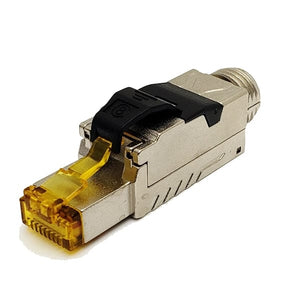
Field termination hardware for structured cabling and coax: RJ45 modular plugs in Cat5e, Cat6, Cat6A and Cat8, pass-through and standard, shielded and unshielded, by the 50 and 100; RG6 F compression connectors, tool-less push-on F connectors, F81 barrel couplers to 3 GHz, right-angle and RCA adapters, and 75 ohm terminators. All bare-copper compatible, RoHS, sold in installer packs; same-day shipping on in-stock items.
| Need | Use |
|---|---|
| Terminate Cat6 patch leads in the field | Cat6 pass-through plug, unshielded; shielded for STP runs |
| Terminate Cat6A or Cat8 shielded cable | Cat6A/7 shielded plug, or Cat8 field-terminable plug with snap-in or screw boot |
| RG6 drops, CATV and satellite | RG6 F compression connector with a compression tool; push-on where no tool is on the truck |
| Join two F cables in a wall plate or splice | F81 coupler, 3 GHz for satellite, 1 GHz for CATV |
| Tight box behind a TV | 90 degree F adapter |
| Cap unused splitter ports | 75 ohm terminator, high return loss |
| Keep MoCA inside the home | MoCA PoE filter at the point of entry |
Jacks and plates: keystone jacks, wall plates. Cable: Cat6 and Cat6A bulk, RG6 coax. Splitters and amplifiers: coax splitters. Guide: PoE and why bare copper matters.


![Conversions Tech Coax Connector, PRO RG6 F Push On Connector, no tool required [100 pcs bag]](http://conversionstech.com/cdn/shop/files/coax-connector-pro-rg6-f-push-on-connector-no-tool-required-100-pcs-bag-1157095970.jpg?crop=center&height=300&v=1745385122&width=300)


Coax Connectors & Adapters FAQ
1. What’s included in the Connectors collection?
The line-up covers F-type couplers, compression and push-on RG6 connectors, 90° adapters, RCA-F adapters, high-return-loss terminators and F-splice barrels—everything you need to patch, extend or retrofit coax drops.
2. What is an F-type connector, and why 75 Ω?
F-type uses the cable’s solid center conductor as its own pin, making a low-cost, low-loss joint that matches the 75 Ω impedance of RG6/RG59 video cable for minimal reflections.
3. Compression vs push-on vs twist-on—what’s best?
Compression connectors install fastest, deliver the highest pull-out force, and seal out moisture better than crimp, solder, or twist-on styles—ideal for outdoor runs or critical RF links.
4. What return-loss spec do your high-frequency F-splice barrels meet?
Our 4 GHz barrels hold >30 dB return loss through 1 GHz and remain >18 dB out to 3 GHz—well inside SCTE limits for DOCSIS 3.1 and satellite.
5. How much insertion loss should I expect?
Precision F-couplers add <0.5 dB from DC–3 GHz, so a pair won’t noticeably affect signal-level budgets.
6. Are the connectors satellite & DOCSIS 3.1 ready?
Yes—rated to 3–4 GHz bandwidth with 75 Ω impedance and low VSWR, they exceed requirements for Ku-band dish feeds and 1218 MHz DOCSIS 3.1 modems.
7. Do I need special tools for compression fittings?
You’ll need a coax prep tool to strip back the jacket and dielectric plus a universal compression tool; the job takes about 60 seconds on RG6.
8. Will these connectors fit both RG59 and RG6?
Yes—our bodies accept 0.275–0.320″ OD; the compression sleeve self-centers on RG59, RG6, and quad-shield RG6Q.
9. How do push-on connectors stay put?
A spring-finger shell bites onto the F threads, giving roughly 15 lb retention—fine for set-top boxes, but use compression outdoors or in vibrating racks.
10. What material and plating are used?
Precision-machined brass bodies with nickel plating resist corrosion; a seize-free thread coating prevents galling.
11. Do right-angle adapters degrade signal?
Our 90° F-adapters add <0.5 dB loss to 3 GHz—negligible for TV or broadband—while solving tight-clearance installs.
12. How weather-tight are these connectors?
Compression bodies include dual O-rings that pass ASTM D1149 UV-aging and withstand 30″ Hg water-vacuum tests—no extra boots required.
13. Can I reuse a compression connector?
No—once the ferrule is crimp-compressed it’s permanent. For field swaps, keep a few spare bags in your kit.
14. What tools verify VSWR after install?
A handheld CATV meter or 3 GHz VNA checks return loss; aim for >25 dB at the band of interest for a perfect run.
15. Do right-angle adapters pass power for amplified antennas?
Yes—DC continuity is <4 mΩ end-to-end, so 5–24 V mast-head amp feeds pass without extra loss.
16. Are bulk packs available?
Absolutely—bags of 50 pcs and cartons of 100 pcs keep installer cost under 30 ¢ per termination.
17. How do I prep cable to avoid stray braid whiskers?
Use a 2-level strip tool (¼″ × ¼″), then fold the braid back evenly; whiskers inside the ferrule are the #1 cause of return-loss fails.
18. Are the parts RoHS & REACH compliant?
Yes—materials contain <0.1 % Pb, Cd, Hg and meet EU 2015/863; declarations ship with every PO.
19. Warranty & support?
Lifetime workmanship warranty plus a 30-day money-back guarantee—our tech team answers install questions within one business day.
20. Where can I download the full spec sheet?
Download the PDF here—insertion-loss curves, return-loss plots, and torque specs included.
*Specifications, features, and availability are subject to change without notice. Conversions Tech reserves the right to make modifications at any time.*